
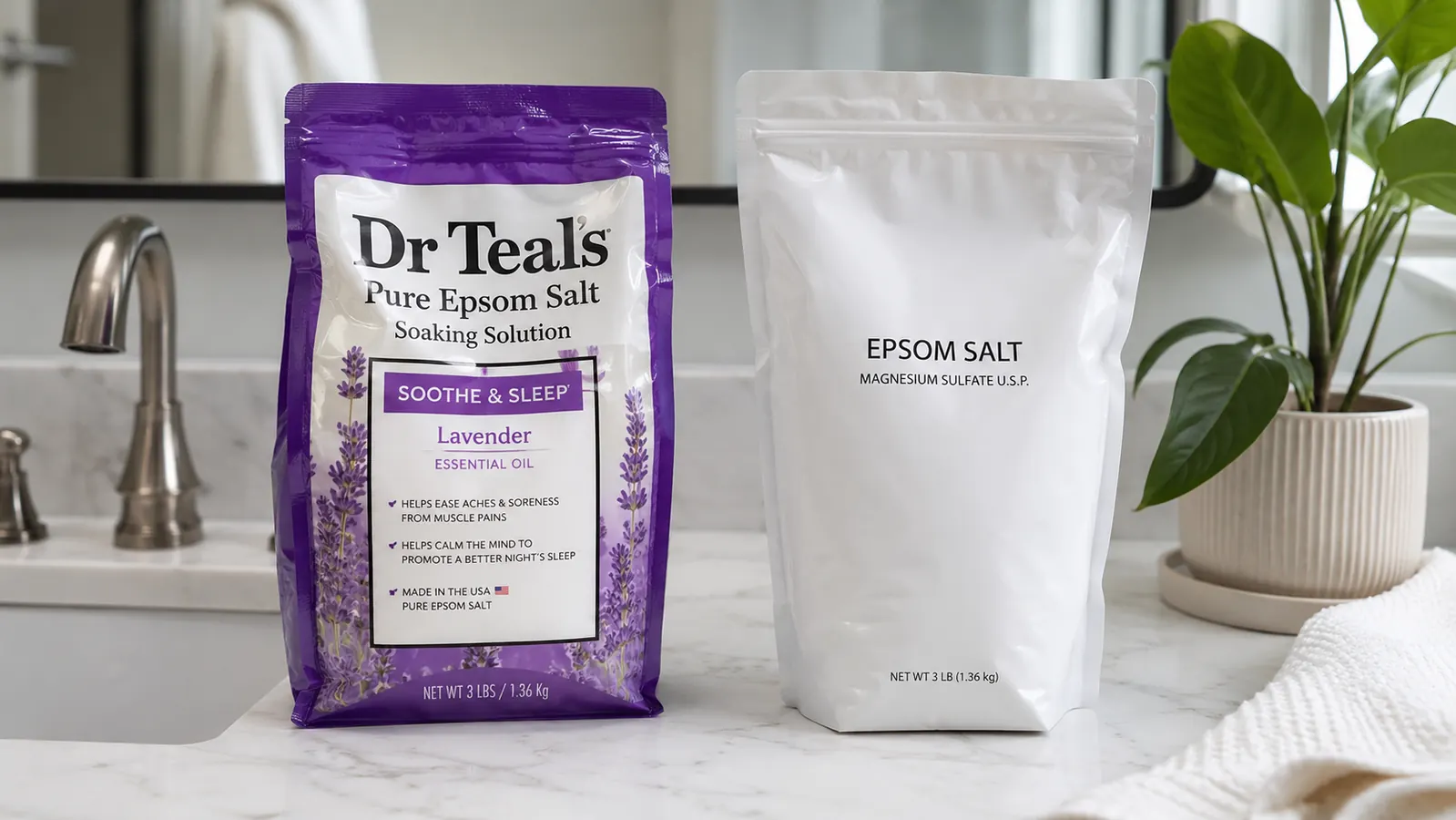
Here is something nobody says out loud when recommending epsom salt baths for muscle recovery: the main reason they feel good has very little to do with magnesium. It has to do with hot water. And if you are spending money on a branded epsom salt specifically because you believe the magnesium is soaking through your skin and doing something meaningful to your muscles, you deserve a straight answer on whether that is actually happening. This review is that straight answer, plus a practical look at whether Dr Teal's Lavender Epsom Salt is worth buying over the plain store-brand bag that costs less.
I am Coach Dana. I work with gym regulars, runners, and people who sit at a desk all day and then try to squeeze in a serious training session before dinner. Epsom salt baths come up constantly in my conversations with clients, usually accompanied by either enthusiastic endorsement or flat-out skepticism. I have now used Dr Teal's extensively, compared it side-by-side with plain epsom salt from three different grocery brands, and dug into the published research on transdermal magnesium. Here is what I actually think.
The Quick Verdict
Dr Teal's earns its premium over plain epsom salt through the lavender essential oil and better packaging, not through any magic mineral absorption. If you want a warm-water recovery ritual that also improves your sleep, it delivers. If you are buying it to fix a magnesium deficiency, you are looking in the wrong place.
Amazon Check Today's Price →Still on the fence between Dr Teal's and plain epsom salt? Here is the version that actually makes the bath worth doing.
The lavender scent is the real differentiator in Dr Teal's. It turns a basic warm soak into something you will actually look forward to after a hard session, which matters more than you might think for building a consistent recovery habit. Check today's price on Amazon and see the current size options.
Amazon Check Today's Price on Amazon →Let's Settle the Magnesium Debate First
Epsom salt is magnesium sulfate. The theory behind using it in a bath is that magnesium absorbs through skin, raising your body's magnesium levels and helping with muscle function, nerve signaling, and recovery. It sounds plausible. Magnesium is involved in hundreds of biochemical processes. Many athletes are mildly deficient. So why not absorb it through a bath?
The research is genuinely mixed, which means neither the true believers nor the total skeptics are fully right. A widely-cited 2004 study by Dr. Rosemary Waring at the University of Birmingham found measurable increases in blood and urine magnesium after epsom salt baths, suggesting some absorption does occur. However, that study had a small sample size and has not been consistently replicated at scale. A more recent critical review found that skin is a reasonably effective barrier to magnesium ions and that absorption, if it occurs, is likely minimal in a standard 20-minute soak. The honest summary: you may absorb a small amount of magnesium, but you are not going to meaningfully correct a deficiency this way. If your magnesium is actually low, magnesium glycinate or magnesium citrate taken orally is far more reliable and far cheaper per dose.
Why does this matter for the Dr Teal's review? Because once you set aside the magnesium-absorption story, what you are actually buying is a warm-water relaxation product with lavender aromatherapy. And that is still genuinely useful for recovery. It just needs to be evaluated on those terms, not on the mineral-supplement terms that most of the marketing implies.
What Dr Teal's Does Differently Versus Plain Epsom Salt
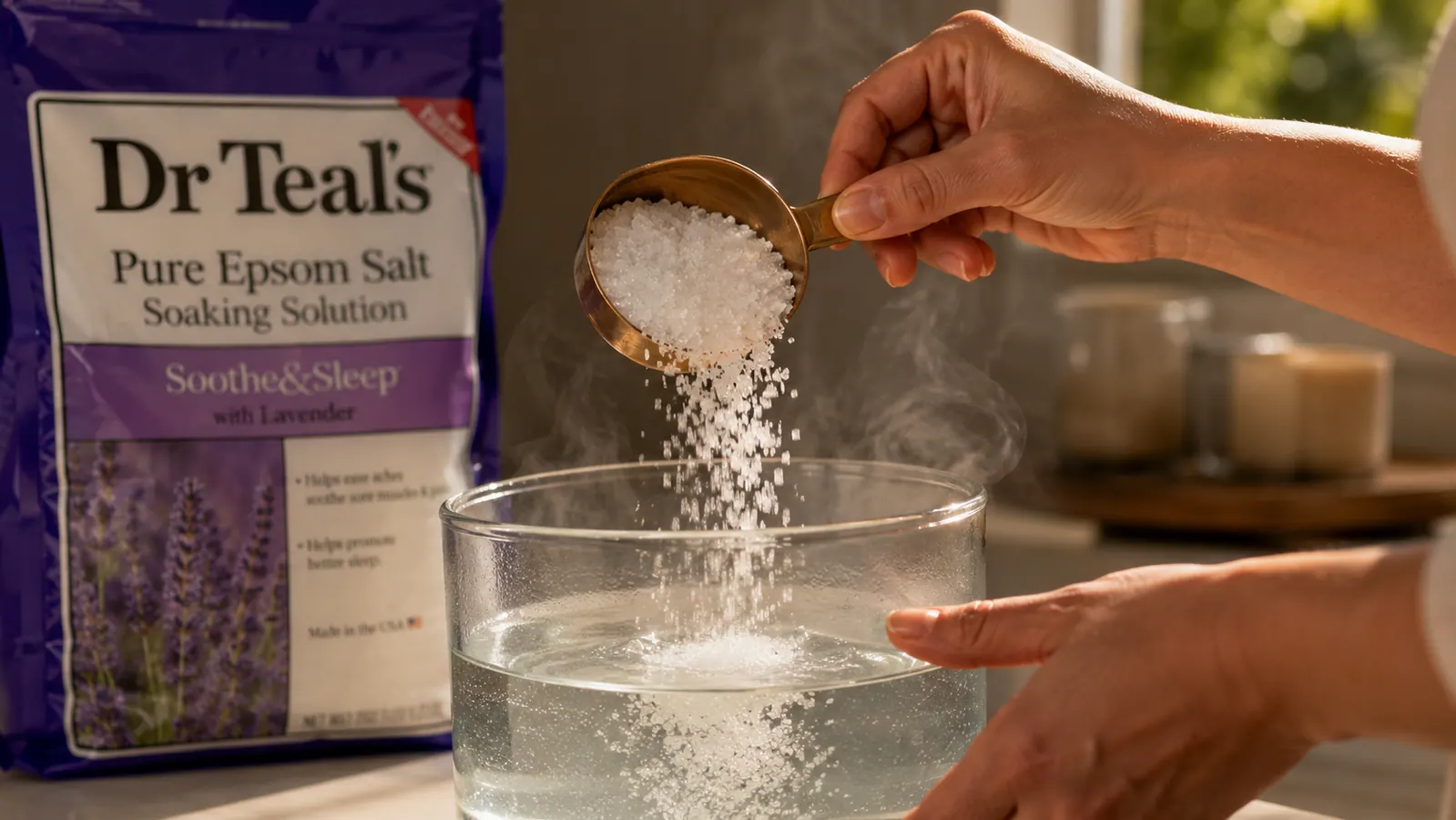
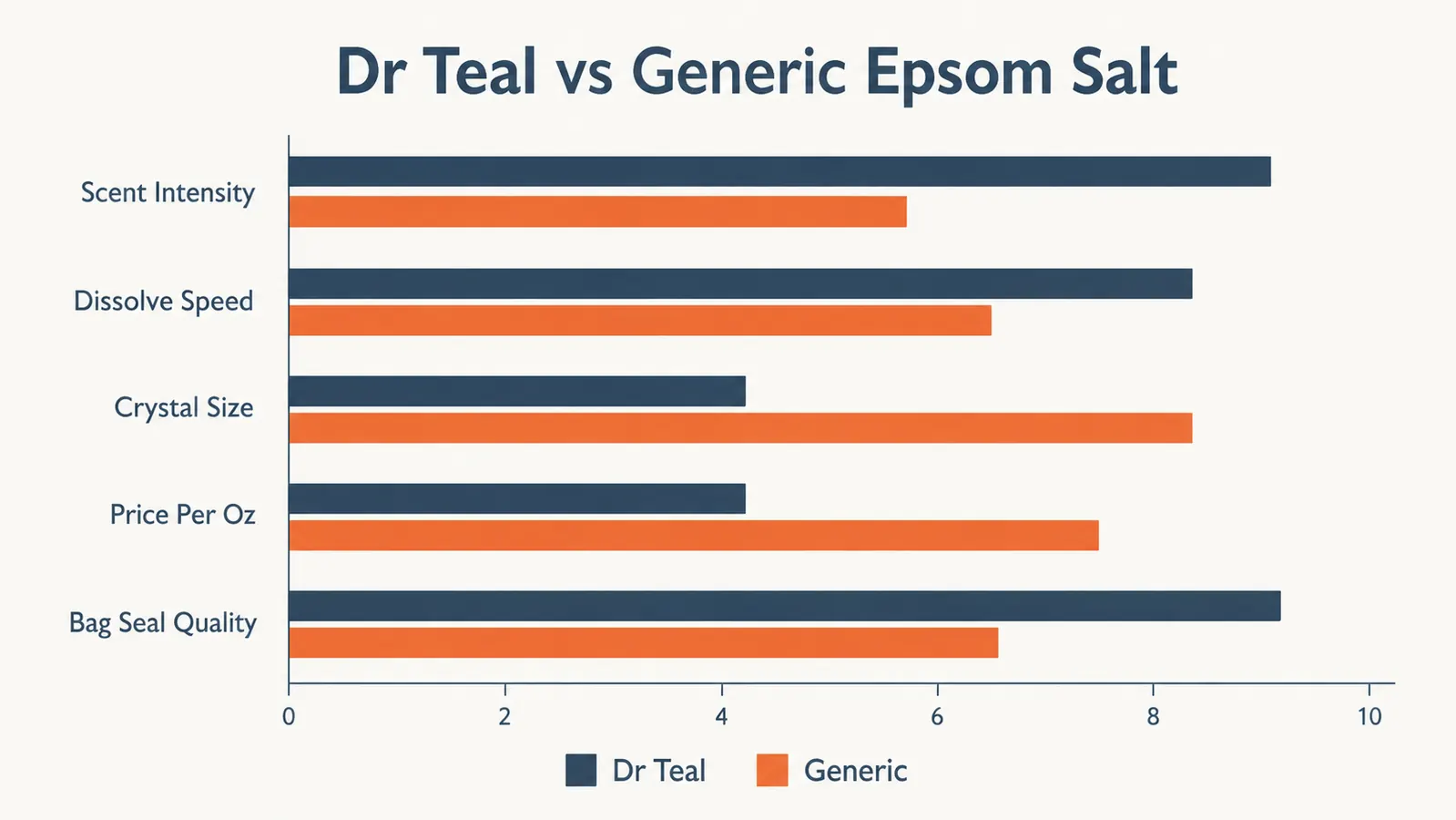
I bought a five-pound bag of store-brand epsom salt from a grocery store chain for comparison. Chemically, it is the same compound: magnesium sulfate. The crystal size was slightly finer than Dr Teal's, which actually dissolved faster in hot water. Both bags were fully dissolved within 90 seconds of warm running water. So dissolve speed is a draw, with a slight edge to generic on that metric.
Where Dr Teal's clearly differs is the lavender essential oil. This is not a synthetic fragrance spritzed on at the factory. The scent behaves like an essential oil rather than a perfume: it is strongest when the crystals first hit the water and bloom as the steam rises, then it settles into a softer background scent by the time the tub is full. In hot water above 104 degrees Fahrenheit, the scent fades faster because heat volatilizes the aromatic compounds more quickly. At a more moderate 100 to 102 degrees, the lavender lasts through a full 20-minute soak. That temperature window matters, and it is something nobody mentions in other reviews.
The generic bag had no scent, obviously. I tried adding a few drops of lavender essential oil to the plain salt to approximate Dr Teal's, and it worked reasonably well. But the oils I already had on hand cost money, and the effort of measuring drops into the tub each time is more friction than just scooping from the Dr Teal's bag. For people who already stock essential oils, DIY-ing it makes sense. For everyone else, the convenience of the pre-scented version is worth the small price difference per soak.
How the Lavender Scent Holds Up in Practice
I tested this specifically because several lower-star Amazon reviews mention the scent being weak or disappearing quickly. What I found was that water temperature is almost entirely responsible for the variation people report. At 105 degrees Fahrenheit, the lavender was strong for about five minutes and then noticeably faded. At 100 degrees, it was steady for the full soak. At 98 degrees, which is barely warmer than body temperature, it actually built slightly as the bath cooled and the aromatics settled.
The other variable is how much salt you use. The label suggests two cups for a standard bathtub. One cup produces a noticeably lighter scent. At two cups, the bathroom smells like a proper spa product rather than a hint of something floral. If you have been underwhelmed by Dr Teal's scent in the past, try using a full two cups and keeping your water temperature at or below 102 degrees. The experience is meaningfully different from a single cup in a very hot bath.
One thing to know: the scent does linger in the bathroom for 30 to 45 minutes after you drain the tub. If you share a bathroom and your housemate is sensitive to fragrances, that is worth knowing before you buy. In my own experience, the lingering scent is mild enough that nobody has complained, but it is not invisible either.
The lavender in Dr Teal's is real essential oil, not synthetic fragrance. Keep your water under 102 degrees and use two full cups, and the scent stays present for the whole soak. That is the detail nobody puts in the one-star reviews.
The Bag, the Seal, and the Crystal Size
Dr Teal's uses a heavy-gauge purple plastic bag with a zip-top closure. The closure on every bag I have used has been reliable through the entire bag. Salt does not clump or harden from moisture intrusion. The zip-top is a genuine advantage over some competitors that use a simple fold-and-tape closure, which eventually lets humidity in and produces a concrete-like block of salt at the bottom of the bag.
The crystals are medium-coarse. Finer crystals dissolve marginally faster, but I have never had an issue with Dr Teal's crystals not fully dissolving in a standard warm-water fill. The size is actually a minor advantage if you are measuring by eye rather than by cup, because the coarser texture is easier to scoop and gauge than very fine powder. There is no dust or fine particle cloud when you pour it, which the finer generic brands sometimes produce.
Honest Use Cases: Where an Epsom Salt Bath Actually Helps
Warm baths, with or without salt, are effective for a few specific things. They raise skin and peripheral muscle temperature, which improves blood flow to the areas just below the skin's surface. They reduce muscle tension by a mechanism that is well-understood: warm water triggers a relaxation response in muscle spindle fibers, the same sensors that govern stretch reflexes. If you carry tension in your shoulders, lower back, or calves from a hard session or from sitting all day, a warm soak genuinely helps that tension reduce more than stretching alone in the same time window.
The lavender adds a meaningful nervous-system component. Lavender aromatherapy has been studied for its effect on the parasympathetic nervous system, the rest-and-digest branch that is suppressed when you are in training mode. Several small studies show reduced heart rate and self-reported anxiety after lavender inhalation. For athletes who train in the evening and then struggle to fall asleep, combining warm water exposure with lavender scent is a practical one-two for shifting from training-state to sleep-ready. The drop in core body temperature when you exit a warm bath also signals the brain that sleep time is approaching, which is a separate and well-established physiological mechanism.
What it does not help with: deep DOMS from a genuinely brutal week, existing tendon irritation, or anything requiring targeted tissue work. A foam roller, lacrosse ball, or percussion massager addresses soft tissue in a way a bath simply cannot. An epsom salt soak and a targeted mobility session are complementary. They are not interchangeable.

Is the Brand Name Worth the Extra Cost?
At current Amazon pricing, Dr Teal's comes out to about 12 cents per ounce in the three-pound bag. Store-brand epsom salt runs around 5 to 7 cents per ounce. At two cups per soak, that is roughly a 70-cent difference per bath in favor of the generic, before accounting for any essential oil you might add to plain salt.
Whether that difference is worth it comes down entirely to whether the lavender scent changes your behavior. If you consistently take the bath with Dr Teal's but skip it or do it less often with plain salt, the brand name pays for itself in the consistency it creates. Recovery tools only work if you use them. A plain-salt bath is technically equivalent in the warm-water category, but it is a less compelling ritual and rituals matter for compliance. If you know yourself well enough to say you will soak just as reliably with plain salt, buy the generic and add a few drops of real lavender oil. If you are honest that the experience matters to whether you actually do it, Dr Teal's is the better choice even at the higher per-ounce cost.
What I Liked
- Dissolves fast in warm water with no gritty residue left in the tub
- Real lavender essential oil scent that genuinely helps you wind down before bed
- Cheap enough to use after every hard session without thinking about cost
- Easy to find in almost any drugstore or grocery store if you run out
- A warm soak is a reliably pleasant, low-effort way to end a heavy training day
Where It Falls Short
- The science on transdermal magnesium absorption is weak, so do not expect a measurable recovery boost from the magnesium itself
- The resealable bag seal gets flaky over time and can let moisture in
- Plain generic Epsom salt does most of the same job for less money if you skip the scent
- Does nothing for an actual injury, it is a comfort and wind-down tool, not a treatment
Who This Is For
Dr Teal's Lavender Epsom Salt is the right call for gym-goers and runners who train three or more days per week, have access to a bathtub, and want a recovery ritual that is easy to maintain and genuinely affects how they feel the next morning. It works especially well for evening trainers who struggle to wind down before sleep. It is also a solid pick for desk workers who carry chronic tension in their upper back, shoulders, and neck, and want a low-effort evening decompression tool. At this price point, the barrier to entry is low enough that there is very little reason not to try it for a month.
Who Should Skip It
If you do not have a bathtub, this product simply does not apply to you. Foot soaks with epsom salt are fine but they do not deliver the full-body warm water exposure that drives the nervous-system and circulatory benefits. If you have a genuine magnesium deficiency confirmed by blood work, a bath is not a reliable fix. Get an oral magnesium supplement and use it consistently. If you are highly sensitive to fragrances or have eczema, psoriasis, or broken skin from training abrasions, skip the lavender variety and check with your doctor before soaking with any additive. If you are looking for targeted trigger-point release or tissue mobilization, this is not a substitute for a lacrosse ball or foam roller. And if you are already soaking consistently with plain epsom salt and happy with the results, there is no reason to switch.
The lavender version is the one worth buying. Here is the price check.
If you are going to build a soak habit, Dr Teal's Lavender Epsom Salt makes the ritual compelling enough that you will actually stick to it. Plain salt works too, but the experience is not the same. Check today's Amazon price and see which bag size makes sense for how often you plan to soak.
Amazon Check Today's Price on Amazon →